All Articles
Infrastructure
Home loan eligibility based on salary Plan to Buy A Home In Hyderabad 2026-2027
Oct 14, 2026
•
3 min read
Learn How Employees with Different Salary Packages Can Plan To Buy A Home in Hyderabad Monthly Money Management and Bank Loan gains and Interests

Salary-wise monthly savings and home loan plan
This is the most important section of your blog. Use a salary comparison table so readers can understand their options quickly.
Assumptions used in the examples
- Salary means monthly take-home pay, not CTC.
- EMI budget is approximately 30% of take-home salary.
- Illustrative home loan interest rate: 8.5% per year.
- Loan tenure: 20 years.
- Planning assumption: 80% of the property price is financed by a loan and 20% is the down payment.
- Additional purchase-cost allowance: 8% of the property price, for planning purposes only. Actual charges vary.
- Monthly savings target: 20% of take-home pay.
These are illustrative calculations, not bank approvals or a live property-price survey.
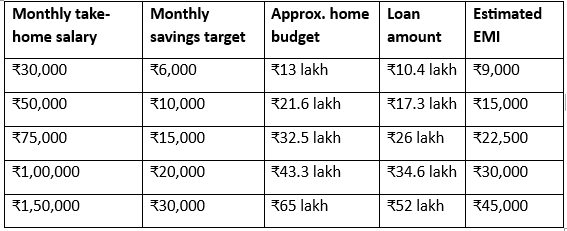 image.png 15.21 KB
Figures are rounded. EMIs are based on an 8.5% annual rate and a 20-year reducing-balance loan. The property budget is a mathematical illustration, not a claim that properties at those prices are available in every Hyderabad locality.
How to explain the table
Employees earning ₹30,000 per month
Start by building emergency savings and reducing existing debts. A smaller property, a longer savings period, or a joint application with an eligible co-borrower may be worth exploring. Avoid committing to a ₹9,000 EMI if essential expenses already consume most of the salary.
Employees earning ₹50,000 per month
A disciplined savings plan can help build the down payment over time. Employees should compare affordable apartments, consider commute costs, and check whether the total monthly housing expense fits their budget.
Employees earning ₹75,000 per month
This income may provide more flexibility to balance a home loan with regular expenses. A buyer can compare smaller apartments, properties farther from central Hyderabad, or a longer down-payment preparation period.
Employees earning ₹1 lakh per month
A buyer may have more options depending on family responsibilities, existing loans, savings, and location. Compare the cost of the property, maintenance charges, commuting costs, and the effect of interest-rate changes.
Employees earning ₹1.5 lakh per month
A higher salary can support a larger loan, but it does not automatically make a larger property affordable. Building a larger down payment or making occasional principal prepayments can help reduce borrowing costs.
How much money should employees save before buying?
The down payment is only one part of the amount needed to buy a home. Buyers should also plan for registration, stamp duty, legal checks, loan processing, furnishing, moving costs, and emergency reserves.
For an illustrative ₹50 lakh property:
Property price
₹50,00,000
Down payment (20%)
Buyer contribution
₹10,00,000
Additional costs (illustrative 8%)
Registration, fees and other costs
₹4,00,000
Total upfront fund target
Excludes a separate emergency fund
₹14,00,000
The 8% allowance is a budgeting assumption, not an official Telangana fee rate. Actual transaction expenses depend on the property, applicable taxes and duties, and the transaction structure.
How long will it take to build the upfront fund?
Assuming the buyer needs ₹14 lakh and starts with no dedicated home-buying savings:
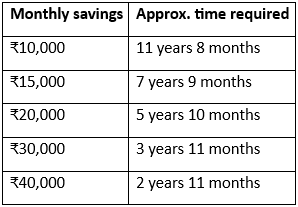 image.png 9.79 KB
These timelines exclude investment returns, salary increases, inflation, and increases in property prices. A property that becomes more expensive during the savings period may require a larger target.
Blog recommendation: Explain that employees should ideally maintain a separate emergency fund rather than use all available savings for the down payment.
Home loan interest rates and bank options
Interest rates can change over time, so your blog should distinguish between published starting rates and the rate a particular borrower actually receives.
Here are useful official bank sources to reference:
 image.png 4.46 KB State Bank of India (SBI)
Its official website lists home loan rates and offers tenures of up to 30 years for eligible borrowers.
 image.png 1003 Bytes
Interest Rates
+1
Official source: SBI home loans and interest rates
 image.png 4.05 KB
ICICI Bank
Its published rates vary by loan amount, credit profile, and borrower category. Its rate page provides standard and fixed-rate information.
 image.png 4.44 KB
ICICI Bank
Official source: ICICI Bank home loan interest rates
For planning, use 8.5% per annum as an illustrative rate in the main calculations, then explain that actual offers may be lower or higher. Avoid promising that every employee will qualify for a particular advertised rate.
What determines the interest rate?
- Credit history and credit score.
- Monthly income and employment stability.
- Existing EMIs and other financial commitments.
- Loan amount, tenure and property valuation.
- The bank's current benchmark and lending policies.
Fixed versus floating interest rates
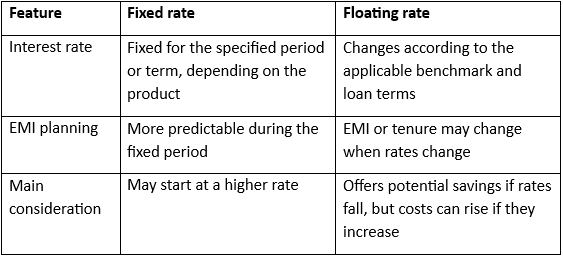 image.png 16.69 KBAlways read the loan agreement carefully. Some products marketed as fixed-rate loans have fixed rates only for a specified period.
How much EMI and interest will an employee pay?
Use this example to make the long-term cost clear to readers.
Illustrative home loan
₹40,00,000
Interest rate
8.5% p.a.
Repayment period
20 years
Monthly EMI
₹34,700
Total interest
₹43.3 lakh
Principal + interest over 20 years
₹83.3 lakh
These figures are approximate and assume a constant rate and regular monthly repayments on a reducing balance. Floating-rate changes, fees and prepayments can change the final total.
How does the repayment period affect interest?
For the same ₹40 lakh loan at 8.5%:
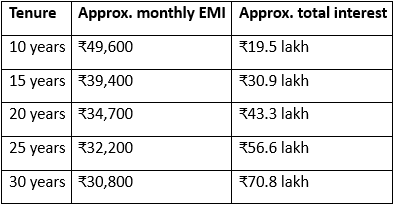 image.png 10.39 KB
A longer tenure reduces the EMI but usually increases the total interest substantially. The best tenure is one that balances a manageable monthly payment with the total borrowing cost.
Home loan eligibility for salaried employees
Your blog should explain that there is no single salary threshold that guarantees approval across all banks.
The lender evaluates the applicant's repayment capacity, income, expenses, liabilities, age, credit history and property documents.
 image.png 6.82 KB
Reserve Bank of India
+1
Common eligibility considerations
- Age:- Must fall within the lender's permitted range.
- Employment:- Stable employment and verifiable income are important.
- Income:- Sufficient income after regular expenses and existing EMIs.
- Credit history:- A strong repayment record may improve the chances of approval and a competitive rate.
- Down payment:- The applicant must arrange the buyer contribution and other upfront expenses.
- Property documents:- The lender must be satisfied with the property's legal status and valuation.
- Co-applicant:- Eligible co-applicant income may help improve the overall borrowing capacity, subject to the lender's rules.
For example, SBI publishes an age range of 18–70 years and a maximum tenure of 30 years for its listed home loan offering, subject to its terms.
 image.png 1003 Bytes
Yono
Documents employees commonly need
1. PAN and identity proof.
2. Address proof.
3. Recent salary slips.
4. Bank statements.
5. Form 16 or applicable income-tax documents.
6. Employment proof, if requested.
7. Property sale agreement and relevant legal documents.
8. Approved building plans and other property records, as applicable.
The lender may ask for additional documents depending on the applicant and property.
 image.png 1.39 KB
South Indian Bank
+1
How to plan the purchase in Hyderabad
Explain that employees should compare locations based on their budget rather than assume one salary can buy a particular type of home throughout Hyderabad.
 image.png 1.41 MB
IT employment corridors
Employees working near Gachibowli and the Financial District can compare commute times, rent versus EMI, and available properties within their actual budget.
 image.png 1.11 MB
Established residential areas
Compare apartment prices, public transport, schools, hospitals, maintenance charges and access to workplaces.
 image.png 1.62 MB
Outer Hyderabad and developing corridors
Buyers may investigate properties farther from major employment hubs, but should independently verify infrastructure, commute time, approvals and resale demand.
Before purchasing, check applicable property approvals and registration details. Telangana's official Bhu Bharati portal provides registration-related information and tools.
Telangana
+1
A practical home-buying roadmap
1. Months 1–3: Review finances
Calculate take-home income, monthly expenses, current EMIs and emergency savings. Set a realistic monthly savings target.
2. Months 4–12: Build financial readiness
Automate savings, avoid unnecessary debt, review credit history and compare home loan options.
3. Years 1–5 or longer: Accumulate the down payment
The actual period depends on the property budget, current savings and monthly contributions. Review the target as income and property prices change.
4. Before booking: Obtain loan assessments
Compare written offers from multiple lenders and get an understanding of likely eligibility, EMI and upfront costs.
5. Before registration: Complete due diligence
Verify title, approvals, encumbrances, agreement terms, applicable taxes and fees, and the lender's requirements.
6. After purchase: Manage repayments
Maintain an emergency reserve, pay EMIs on time and consider principal prepayments only when they fit the household's broader financial needs.
Frequently Asked Questions
1. What salary is required to buy a house in Hyderabad?
There is no universal minimum salary. The affordable property price depends on take-home income, existing obligations, down payment, interest rate, tenure and living expenses.
2. Can someone earning ₹30,000 per month get a home loan?
Possibly, depending on the lender's eligibility assessment, other debts, credit history and the property. A smaller loan or eligible joint application may be necessary.
3. How much down payment should an employee save?
A 20% down payment is a useful planning assumption, but the required contribution depends on the lender's loan-to-value rules and the property. Registration and other costs may need to be paid separately.
4. Is a 20-year or 30-year home loan better?
A 20-year loan generally has a higher EMI but lower total interest than a 30-year loan at the same rate. Choose a tenure that is sustainable for your finances.
5. How can employees reduce home loan interest?
They can compare lender offers, maintain a good repayment history, make a larger down payment when feasible, and consider part-prepayments when financially appropriate.
6. Are registration charges included in the home loan?
Do not assume so. Plan to pay applicable charges separately unless the lender and transaction terms explicitly confirm otherwise. Check current Telangana registration charges through the official Bhu Bharathi
https://propmintrealty.com/
https://whatsapp.com/channel/0029VbCQhoIDJ6HAi7X93H2X
Related Articles


Key Highlights
- Salary-Wise Home Buying Plan in Hyderabad
- Down Payment and Monthly Savings Strategy
- Home Loan EMI and Interest Rate Planning
- Home Loan Eligibility and Required Documents
- Choosing the Right Location and Planning Your Purchase